
Anatomy Of A High Security Door: Steel Core vs Wood Core
Article Summary
- A door’s core, frame, hinges, and locking system all contribute to security.
- Reinforced steel construction provides greater resistance to impact, prying, and forced entry than many wood-core designs.
- Shield Security Doors offers reinforced solutions designed for residential, commercial, and high-security applications.
What makes a door burglar-proof? Is it the lock or the material underneath? A strong lock can only do so much when the door itself can be easily split or forced open. This is why security doors are better; they are made with stronger materials, reinforced construction, and secure hardware, making them almost impenetrable, especially to brute force.
But if you are still torn between door types, Shield Security Doors will guide you. In this article, we will break down the anatomy of a security door and explain the difference between a steel core and a wooden frame.
Why a High-Security Door Is Not Just The Type Of Lock A Door Has
Imagine a burglar repeatedly kicks on the deadbolt side of your front door. Although the lock itself is strong enough to resist the burglar’s efforts, if the surrounding frame material (wood) breaks down from repeated pounding, you could still have a broken door. That is why a “high-security” door is about much more than just purchasing a higher quality lock.
In fact, when you upgrade locks alone, it creates a false sense of security for you as a homeowner because the burglar will likely focus their attacks on the material surrounding the lock. The key is what’s underneath.
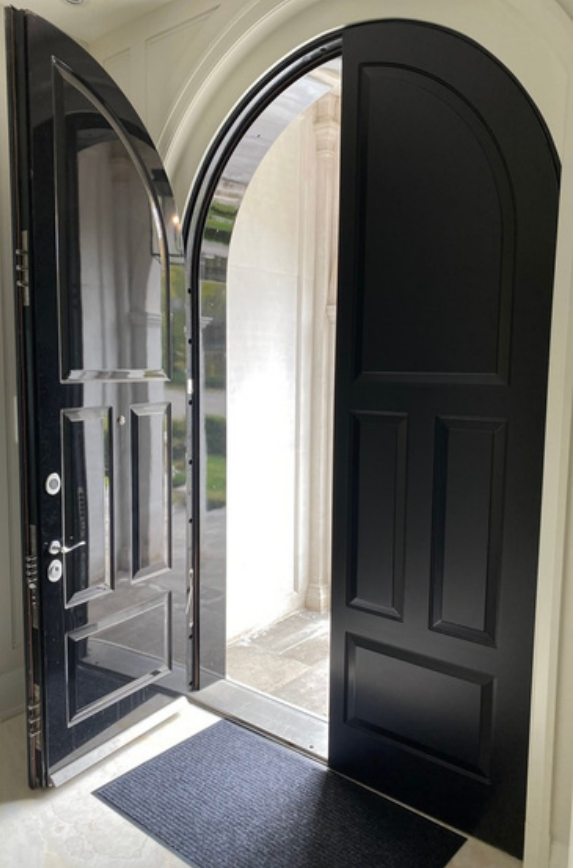
Both a commercial and residential security door comes with a reinforced core, steel construction, strong hinges, and secure locking points, all working together to make the entire entry point harder to defeat.
What Is Inside a Typical Wooden Door?
Not all wooden doors are made equally. Many use lighter, hollow materials, while others have solid or engineered wood. The difference in construction explains that just because a door is made of wood doesn’t mean it will withstand a break-in attempt.
1. Hollow-Core Construction
The primary objective for hollow-core doors was to create a very lightweight door that would also be inexpensive to manufacture and simple to open and close. The internal portion of this door includes cardboard honeycomb, paper or cardboard strips, foam, or other low-density plastic materials.
While this creates some structural integrity (compared to no internal material), these materials can’t reliably resist direct impact or pry forces as reliably as a more robustly constructed door.
2. Solid-Core or Wood Construction
A solid-core door provides more strength and substance than a hollow-core door and may contain solid wood, engineered wood, composite materials, or added wood reinforcement. Solid-core doors may provide better durability and impact resistance.
However, a heavy wooden door is not always the best security, especially if you need a commercial security door. A door’s overall resistance to forced entry depends on the core composition, the frame, the hinges, the locking hardware, and the assembly of all elements of the door system.
3. Typical Locking Hardware
Most standard residential doors are equipped with a single primary lock (deadbolt); however, depending on the specific door style and installation configuration can vary. Adding secondary locks can increase security; however, they do not provide structural support to the door itself. If the surrounding material (frame), hinge side, or other portions of the door fail under applied force, the robust lock won’t matter anymore.
What Is a High-Security Door Made Of?
The biggest difference between an ordinary door and a high-security door is what lies beneath the surface. High-security doors, like our Shield Embassy series, are built with structural elements that combine to form a single continuous barrier, rather than relying on the lock as the primary element. The structure is enhanced by using stronger materials and reinforcing each component to create a single, unbroken barrier.
1. Steel or Reinforced-Steel Construction
Steel doors are strengthened from the inside with steel sheeting, steel core sections, other structural steel members, and internal reinforcements. All these components provide greater strength to the door’s interior, helping combat distortion, cracking, and bending when force is applied. Unlike weaker materials used to support the locking hardware, the reinforced interior provides a much stronger base for all parts of the assembly.
2. Reinforced Hinges and Locking Points
Even if the door is well-constructed, without strong connection points, it will fail. Stronger hinges and locks with internal support naturally transfer force into the door and frame, so the impact does not concentrate in a single weak area, making it harder to pry open or break down the door.
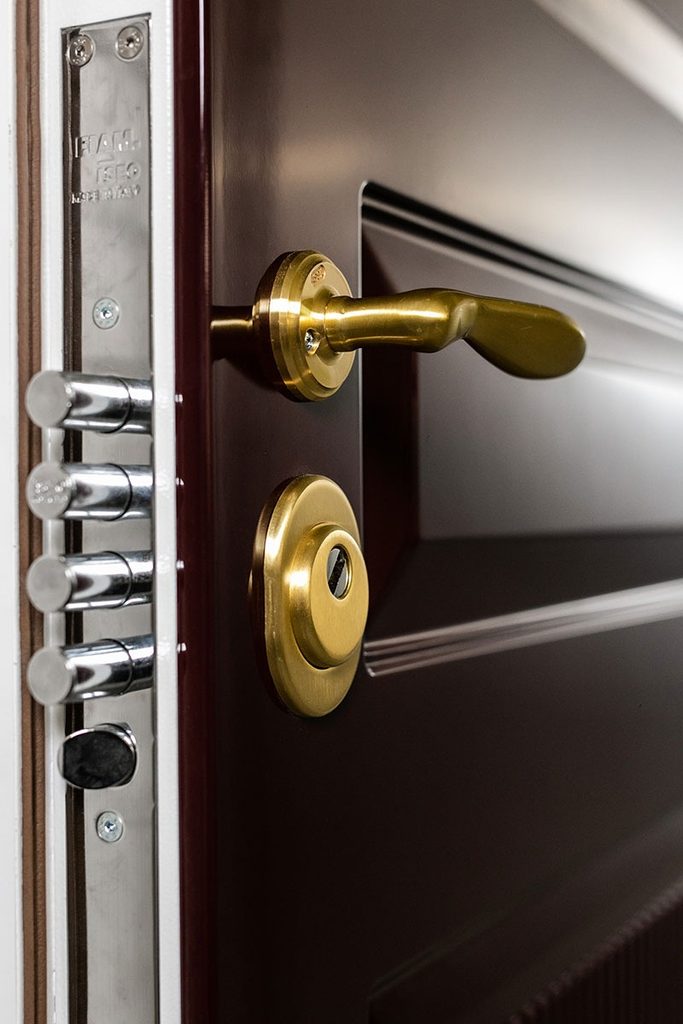
3. Multi-Point Locking Systems
Multi-point locking systems secure a door at several locations along its length, with a separate lock at each area, rather than a single central lock. This can help to provide more consistent resistance to applied force. However, multi-lock systems alone do not equal high security. Both the locking mechanisms and their associated supports need to function harmoniously for the overall system to be effective.
Steel vs. Wood: Why the Difference Matters During a Break-In
A person attempting to break in by kicking a locked door has to contend with two factors: the locking mechanism and the door’s ability to accept, disperse, and withstand the applied force.
This is where differences in the materials used for construction (Steel core vs wood core door) become most apparent.
1. Kicking and Blunt-Force Attacks
Multiple kicks or large impacts may cause a wooden door to crack, split, or fail at a “weak link” (usually the area around the lock, hinges, or door frame). However, steel doors are specifically engineered to resist impact by distributing the force of each blow evenly throughout the entire door assembly.
2. Crowbar and Prying Attacks
A crowbar uses focused leverage on the door, frame, locks, or hinges in order to pry the door open. Lightweight wood structures tend to bend, crack, or break under sufficient force, allowing some opening to occur. Steel-reinforced doors, including bulletproof doors, are made with stiffer barriers that cause less deformation under prolonged prying forces on the door or its hardware.
3. Time Matters
While any door can be broken into with enough time, the time required to breach it makes a huge difference. Additional reinforcement can increase the time required to breach it, produce loud noises that alert people inside the structure, and increase the effort and risk for the burglar attempting to enter. These factors can deter an intruder and give occupants, security professionals, or law enforcement officials more time to react.
Shield Security Doors meet these criteria, with products tested by independent security firms and law enforcement against State Department Forced Entry Standards, helping ensure occupants and authorities have additional time to respond to an attack.
For example, the Shield Security Door Fortress Series provides approximately 15 minutes of forced-entry resistance (FE15), with options for ballistic protection tested to UL Level 3 or UL Level 8 standards.
A Door Is Only as Strong as Its Weakest Component
Imagine adding an advanced, multi-point lock to a door that is vulnerable to splitting under pressure. Even if the lock is top-quality, the door will fail. This is why security depends on the complete entry system: the door, its frame, hinges, locking points, and their installation.
Shield Security Doors offers various U.S.-made security doors, including residential and commercial models, as well as several high-security options. Visit our catalog to find a steel security door for a home, business, or commercial building, then contact our experts to begin your consultation.